
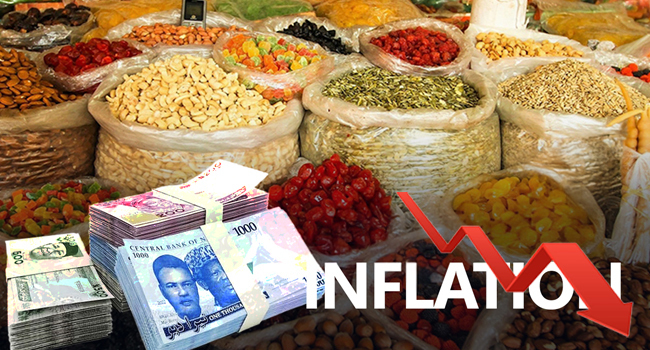
Nigeria’s headline inflation rate dropped from 15.91 per cent in June to 15.43 per cent in July 2026, according to newly released data by the National Bureau of Statistics (NBS).
In its Consumer Price Index (CPI) report released on Monday, the NBS noted that the July 2026 headline inflation rate “showed a decrease of 0.48 per cent compared to the June 2026 headline inflation rate.”
“On a month-on-month basis, the headline inflation rate in July 2026 was 1.57 per cent, which was 0.09 percentage points lower than the rate recorded in June 2026 (1.66 per cent),” the bureau said.
“This means that in July 2026, the rate of increase in the average price level was lower than the rate of increase in the average price level in June 2026.”
Meanwhile, the NBS noted that the food inflation rate stood at 20.31 per cent in July 2026 on a year-on-year basis.
The rise in food inflation was attributed to increases in the prices of rice, water yam and plantain.
“On a month-on-month basis, the Food inflation rate in July 2026 was 5.56 per cent, up by 1.82 percentage points from June 2026 (3.75 per cent),” the NBS added.
“The food inflation rate in July 2026 was 20.31 per cent on a year-on-year basis and stood at 26.20 per cent in the same month of the preceding year (July 2025),” the bureau said.
The NBS attributed the month-on-month change in food inflation to variations in the average prices of products including crayfish, fresh pepper, fresh onions, carrots, rice, water yam, fresh tomatoes, garri, plantain, beef, eggs, guinea corn, ginger and plantain flour, among others.
On a month-on-month basis, the NBS said food inflation was highest in Adamawa (17.02 per cent), Lagos (13.48 per cent), and Borno (13.26 per cent), while Jigawa (-3.68 per cent), Kebbi (-3.67 per cent), and Bauchi (-1.85 per cent) recorded declines.
Food inflation on a year-on-year basis was highest in Adamawa (51.36 per cent), Katsina (30.84 per cent), and Zamfara (30.65 per cent) in July 2026.
Meanwhile, Borno (-0.31 per cent), Nasarawa (6.88 per cent), and Kebbi (12.50 per cent) recorded the slowest increases in food inflation on a year-on-year basis.
