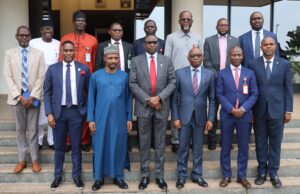
The Executive Chairman of the Economic and Financial Crimes Commission (EFCC), Ola Olukoyede, on Wednesday, July 8, 2026, convened a strategic meeting of the nation’s anti-corruption agencies at the Commission’s corporate headquarters in Abuja.
The roundtable was aimed at fostering a stronger and more enduring framework for collaboration and synergy among the EFCC, the Independent Corrupt Practices and Other Related Offences Commission (ICPC), the Code of Conduct Bureau (CCB), and the Bureau of Public Procurement (BPP) to achieve better outcomes in the fight against corruption, economic crimes and financial crimes in the country.
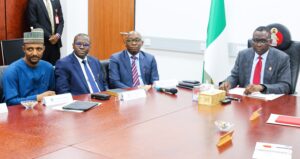
The meeting was attended by the Director-General of the BPP, Dr. Adebowale Adedokun; the Chairman of the ICPC, Dr. Musa Adamu Aliyu, SAN; and the Chairman of the CCB, Dr. Abdullahi Usman Bello. Olukoyede explained that he convened the meeting to bring the anti-graft agencies together to deepen collaboration and synergy for the effective discharge of their anti-corruption mandates.
He identified procurement and contract fraud as the most severe forms of public sector corruption and financial crime in the country.
“More than 80 percent of public sector corruption is caused by contract and procurement fraud and, if you look at its impact on the economy, our social life, the health sector and other areas, you will discover that it is quite huge. If we can reduce this to the barest minimum, we would have gone a long way in realising our mandates. If we can effectively deal with contract and procurement fraud in Nigeria, probably within the next one year, the impact will be felt everywhere,” he said.
He stressed the need for the three law enforcement agencies to work more closely with the BPP as the nation’s procurement regulator.
“The essence of this meeting is to also work with the BPP. The BPP is a regulator, while the three of us are enforcers. In fighting public and private sector procurement and contract fraud, if you don’t work with the regulator, technically speaking, a lot of things will be missed. It is not just about waiting for people to steal public funds. It is about prevention and risk management, and that is where the regulator comes in. They have the technical depth of the procurement process, which some of us may not have. If we work together and establish a sustainable institutional partnership between the law enforcement agencies and the BPP, it will go a long way in helping us reduce contract and procurement fraud. That is basically the objective of this meeting,” he said.
Speaking further, Olukoyede noted that many provisions of the Public Procurement Act have yet to be fully implemented.
“That is what the BPP Director-General is here to draw our attention to. He will also enlighten us on some of these regulations that can strengthen our work,” he said.
He added that greater collaboration among anti-corruption agencies would improve information and intelligence sharing while facilitating the timely investigation and prosecution of cases.
“I have discovered that there is really nothing to compete about. We can conduct joint investigations. Sometimes it may be necessary for us to carry out joint monitoring. I believe that if we do these with the BPP, it will help us a lot. Capacity building is also very key,” he said.
Olukoyede proposed the development of a Standard Operating Procedure (SOP) to strengthen inter-agency cooperation, clearly define the responsibilities of each institution and ensure the confidential handling of information.
“That is why we decided to convene this meeting. Going forward, we believe we should hold this meeting on a quarterly basis so that we can review our resolutions and ultimately help our nation,” he said.
Supporting the EFCC Chairman’s position, the ICPC Chairman called for greater synergy and collaboration among anti-corruption agencies.
“If the ICPC, CCB, NFIU and EFCC come together, it will give Nigerians confidence that we are genuinely working together to fight corruption. It will also help us avoid duplication because there are many cases that are reported to the EFCC, then to the ICPC and later to the Code of Conduct Bureau.”
He added: “This is an area of concern for us. Whenever I receive a petition that falls outside our mandate, I do not act on it. I simply refer it to either the CCB, the EFCC or the Police. That is why meetings like this are very important. We also need to leverage technology to eliminate duplication.”
The Chairman of the CCB, while lamenting the impact of corruption in the country, presented infographics indicating that between ₦7 trillion and ₦25 trillion had been lost to corruption. He also disclosed that Nigeria has about five million public servants and agreed that procurement fraud remains one of the greatest challenges within the public sector.
He emphasised the need for stronger collaboration, reiterating that partnership among the NFIU, EFCC and ICPC is essential.
“The NFIU can provide intelligence for us, the EFCC can investigate financial crimes relating to procurement, while the ICPC can address systemic corruption.”
In his presentation, the Director-General of the BPP took participants through key regulatory issues that anti-corruption agencies need to understand. Speaking on the theme, “Why Public Procurement Matters,” he highlighted the consequences of weak procurement systems, including the waste of public resources, cost overruns, project abandonment, poor-quality infrastructure and corruption.
He also shed light on public procurement reforms, including legal and institutional reforms, capacity building and inter-agency collaboration.
“The most effective anti-corruption strategy is not merely to pursue wrongdoing after it occurs, but to design procurement systems where corruption cannot thrive.”
He further stated that effective public procurement reform requires five key elements: legal and institutional reforms, governance and accountability, strategic procurement, digital procurement, and improved market operations.
Participants also discussed issues including procurement without cash backing, deliberate breaches of procurement procedures, abuse of procurement laws and other related concerns.