
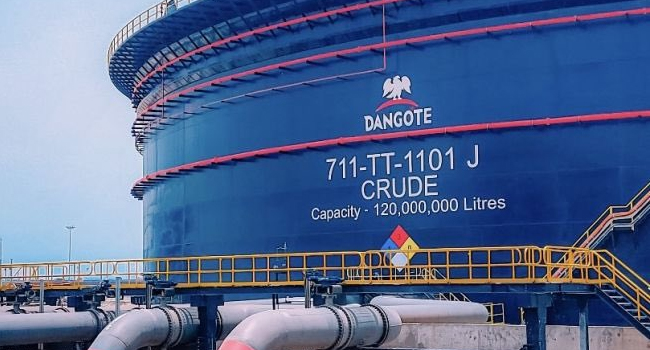
Dangote Petroleum Refinery has revised its ex-depot prices, increasing the gantry price of Premium Motor Spirit (PMS), also known as petrol, to ₦1,175 per litre, while Automotive Gas Oil (AGO), commonly known as diesel, has been raised to ₦1,620 per litre.
The latest revision marks the fourth consecutive price review in less than two weeks amid global market volatility, according to a report by Petroleumprice.ng.
Quoting industry sources, the report noted that the new pricing template has been communicated to marketers, following earlier adjustments this month.
Under the revised structure, the ₦1,175 per litre petrol price reflects a significant jump from the previous ₦995 per litre, while diesel has surged sharply from its prior ₦1,430 per litre level, underlining the continued upward trend in domestic fuel pricing.
The increases coincide with a sharp rise in international crude oil benchmarks as of 1:00 pm WAT: Brent crude at $102.8 (+10.91%) and WTI crude at $101.0 (+11.08%), driven by the Middle East energy crisis.
The development is likely to have a ripple effect across Nigeria’s downstream petroleum market, as depot operators and fuel marketers adjust supply costs in response to the revised prices announced by the country’s largest refining facility.
The refinery had yet to issue an official statement on the development as of the time of filing this report.
Oil prices surged by 30 per cent on Monday on fears over supply disruptions in the Middle East, as the US-Israeli war against Iran continued into a second week with no sign of easing.
Concerns that the conflict could drag on intensified after US President Donald Trump said only the “unconditional surrender” of Iran would end the war.
He added over the weekend that the spike in prices was a “small price to pay” to eliminate Iran’s nuclear threat, reiterating the White House’s insistence that the rise is temporary.
Since the beginning of the war, WTI has risen by more than 75 per cent, while Brent has increased by over 60 per cent.
Attacks on oilfields were reported in southern Iraq and in the northern autonomous Kurdistan region, forcing a US-run oilfield to cease production. Meanwhile, the United Arab Emirates and Kuwait have begun reducing output.
This comes as maritime traffic in the Strait of Hormuz — through which about one-fifth of global crude oil and gas supplies pass — has been halted since the war began on February 28.
